Genesis
12:1-4 Now the Lord said to Abram, “Go from your country and
your kindred and your father’s house to the land that I will show you. I
will make of you a great nation, and I will bless you, and make your name great,
so that you will be a blessing. I will bless those who bless you, and the
one who curses you I will curse; and in you all the families of the earth shall
be blessed.”
So Abram
went, as the Lord had told him;
John 3:1-17 Now there was a Pharisee named Nicodemus, a
leader of the Jews. He came to
Jesus by night and said to him, “Rabbi, we know that you are a teacher who has
come from God; for no one can do these signs that you do apart from the
presence of God.” Jesus answered
him, “Very truly, I tell you, no one can see the kingdom of God without being
born from above.” Nicodemus said
to him, “How can anyone be born after having grown old? Can one enter a second
time into the mother’s womb and be born?” Jesus
answered, “Very truly, I tell you, no one can enter the kingdom of God without
being born of water and Spirit. What
is born of the flesh is flesh, and what is born of the Spirit is spirit. Do not be astonished that I said to
you, ‘You must be born from above.’ The
wind blows where it chooses, and you hear the sound of it, but you do not know
where it comes from or where it goes. So it is with everyone who is born of the
Spirit.” Nicodemus said to him,
“How can these things be?” Jesus answered him, “Are you a teacher of Israel,
and yet you do not understand these things? “Very
truly, I tell you, we speak of what we know and testify to what we have seen;
yet you do not receive our testimony. If
I have told you about earthly things and you do not believe, how can you
believe if I tell you about heavenly things? No
one has ascended into heaven except the one who descended from heaven, the Son
of Man. And just as Moses lifted
up the serpent in the wilderness, so must the Son of Man be lifted up, that whoever believes in him may have
eternal life. “For God so loved
the world that he gave his only Son, so that everyone who believes in him may
not perish but may have eternal life. “Indeed, God did not send the Son into
the world to condemn the world, but in order that the world might be saved
through him.
+++
I
read an Anne Tyler novel a number of years ago called Ladder of Years. It’s a story about a woman named Delia who
just picks herself up and walks away from it all during a family vacation at
the beach. Really. She just gets up, wipes the sand off her
legs, and walks away with nothing but her beach cover up and her purse. Delia hitches a ride to the nearest town and
starts a new life.
This
story came at the right time in my life.
I had a house full of kids. This
was a fantasy I could really get into. I
would never have just walked away from my family. But what an attractive idea that can be. Sometimes you just want to walk away and
start over. Usually there are enough
things holding you back to prevent you from doing it.
I
wonder what was holding back Abram when God called him to walk away from his
home and his people, and go to a place God would show him. There must have been something – or a few
things – on his mind.
But
we don’t know. The text doesn’t
say. It just says that Abram went, as
the Lord told him.
Sometimes
discipleship happens like that. But not
always.
Other
times it’s more like Nicodemus, who approached Jesus hesitantly and stealthily. He came in the dark of night. And it’s no wonder he came at night. After all, he was a Pharisee – a teacher of
Israel.
He
was breaking ranks with his fellows, who were, of course, emphatically opposed
to Jesus. Something pulled at Nicodemus,
leading him to make this night visit.
But he came with all his hesitation and doubts and uncertainties, and a
certain amount of resistance to being made new – some fear of what was unknown.
And
this baggage Nicodemus brought with him seemed to make it impossible for him to
take that leap in understanding. Nicodemus
asks Jesus, how can these things be? and
you can almost hear the quiver in his voice as he asks.
Nicodemus
arrives in the dark and he leaves in the dark, seeming to have gained
nothing. He is no farther along on the
road to discipleship. Maybe we know,
ourselves, what it’s like to be in the dark, unable to take that step into
something new.
Yet,
Lent is just that – beginning anew. When
we take up a Lenten discipline we are, in a sense, hitting the reset button on
our spiritual lives.
In
the beginning, Lent was a season of preparation for new Christians, preparing
for their baptism, which would take place on Easter. And the traditional Lenten discipline was the
fast.
It
was taken very seriously. Typically,
fasting was observed Monday through Saturday, when they were permitted only one
meal at the end of the day – a vegetarian meal.
Sundays were exceptions, because every Sunday is considered a little
Easter – a feast day, a celebration of the resurrection.
It
is rare now for Christians to observe such a strict Lenten discipline. When we think of a Lenten fast, we might
think of giving up sweets or caffeine. We
consider it optional. And, very likely,
we are not really sure what the point of it is.
This
is probably why many Christians now embrace the idea of taking something up
rather than giving something up during Lent – that feels more purposeful,
somehow. Yet the Lenten fast is a spiritual
practice that still may have much use for us.
We might just need a new angle.
What if instead of speaking about giving
something up, we rephrased it as letting
something go?
Consider
today’s scriptures from this viewpoint.
What did Abram need to let go when he followed God’s call into the
wilderness? He needed to let go of home,
the land of Haran. He had to let go of
family. But it went even further than
that. He also had to let go of his
identity, in a sense. No longer was he
Terah’s son, for any practical purpose.
Wherever he went, he would be an unknown quantity, and he would be
redefined by whatever circumstances he encountered.
Abram
had to let go of many of the things he knew about himself for the sake of
learning something new about himself. When
Abram followed God’s call he really pressed the reset button on his life. I
wonder how hard that was to do.
Nicodemus
was also asked to let go of some things.
He needed to let go of certain ways of looking at the world – this idea
of what it means to be born, for example.
He needed to let go of his concepts of truth, of certainty. He needed to be able to let go of the way he
understood God’s actions in the world, and even who he was in relation to God
and all of humankind. Nicodemus was
being asked to let go of some really big things – intellectually and
spiritually.
And
Nicodemus, as we see, was not very successful at it. We felt sorry for Nicodemus at the roundtable
this week. We sympathized with him,
because we certainly know what it is like to be utterly confused by something,
like he was confused by Jesus. And we
wondered aloud whatever became of Nic.
I
can tell you that Nicodemus made another appearance in the story in chapter 7. Jesus is teaching among crowds of people at a
religious festival. The Pharisees are
about ready to have him arrested, but Nicodemus is there and he says something
to the others to slow things down.
Nicodemus
makes one final appearance. After Jesus
is crucified. Joseph of Arimathea and
Nicodemus take his body from the cross to the tomb. Nicodemus brings the myrrh for his burial.
Is
the jury still out on Nicodemus? Possibly. But there is hope for Nicodemus. He appears to have stepped out into some new
territory; he is letting go of some things for the sake of being present to the
new things.
What
is it in your life that you need to let go of this season. What is causing you anxiety? Anger?
Fear? What is creating a barrier
between you and the extraordinary thing God would like to do with you?
Here
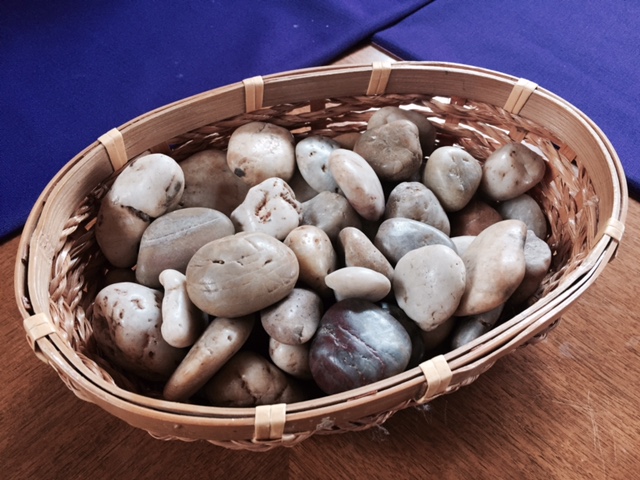
is an exercise you can try. Find a rock small
enough to hold in your hand. Imagine
this rock being the embodiment of the thing God is urging you to let go. You hold this in your hand, but you have the
power to let it go. When you are ready find
a body of water, or just fill a bucket, and drop your rock into the water. As you feel your hand letting go, as you
watch the rock sink into the water, know that a weight has been lifted, a
burden dropped. You are, in some way,
freed.
Reset.


